
Ventilation in the Tunnel
The optimal temperatures for strawberry plants in polytunnels are around 20-25°C during the day and around 10°C at night. For early strawberry cultivation, temperatures can be increased to around 28°C, up until the beginning of flowering. Depending on the region and weather, ventilation begins at the end of March. The doors at the entrance of the tunnel are opened, and the side panels are rolled up. Initially, ventilation takes place during the day, except in rainy weather, and the tunnel is closed again at night when temperatures are cooler. From the start of flowering, daily ventilation (day and night) is recommended to ensure the blossoms dry thoroughly and that pollination is successful. Continuous ventilation helps maintain the firmness of the strawberries.
Important:
- Ventilate when temperatures exceed 25°C (77°F)
- 28°C (82°F) is suitable for strawberries in the tunnel
- Ventilate continuously from flowering onwards
- From fruit development onwards, the tunnels must be fully ventilated day and night
- Fruit firmness
- Monitoring options:
-
- Min/Max Thermometer
- Weather station with SMS alerts


Fertilization and Irrigation
A soil analysis is recommended before planting, as it can provide valuable information about water and nutrient availability. The existing soil moisture should also be taken into account. Irrigation is generally carried out using a drip irrigation system. In spring, depending on the region and weather, watering once a week is usually sufficient. During the harvest season, when temperatures are warm, watering should be done once or twice a day.
To ensure the plants receive sufficient nutrients, it is important to create or have a professional fertilization plan created. Fertilizer is applied using a fertilizer tank or a professional irrigation system. It is important that each variety is irrigated and fertilized separately.
Facts:
- Soil analysis before planting
- Fertilization plan created
- Fertilizer application using a fertilizer tank or professional irrigation system
- Irrigate each variety separately
Recommended Procedure for Fertilizing the Substrate
Recommended Guidelines:
- pH value in the root zone
- Soil: 6.5-7.0 Coconut
- coir: 5.5-6.0
- Peat: 5.3-5.8
- pH value in water
- Soil: 5.8-6.1
- Coconut coir: 5.3-5.5
- Peat: 5.5-5.8
Fertilizer Calculation
- Normally, two formulas are used:
- Starting fertilization (planting, growth)
- Fruit fertilization (flowering, fruit development, harvest)
- Depending on the consultant and laboratory, the formula is given in mg/liter or mmol/liter
- Mol = quantity of atoms
- mmol/liter is scientifically “correct,” but mg/liter is simpler in practice
Irrigation
To ensure plants receive sufficient water, it’s important to water them frequently with small amounts. If watering every 30-90 minutes, the recommended duration is 3-5 minutes. However, this can vary depending on the weather, growth stage, and substrate type. The first watering should be done approximately 2 hours after sunrise, and the last approximately 1-3 hours before sunset.
Almost every watering should include a small amount of runoff water, except in the early morning hours. Note that the parameters need to be adjusted at higher temperatures. In this case, a higher runoff percentage and a lower EC value are required. A light-controlled irrigation system can also be helpful.
Important:
- Calculate the maximum water supply requirement.
- Acid enrichment is necessary.
- Systems require at least 24 hours to ensure the pH value is within the correct range.
- Always oversize the water reservoir; it will usually end up being too small.
- A dripper every 20 cm is optimal for strawberries.
- The irrigation system must be able to water the plant every 30–40 minutes.
- The bicarbonate content in the water must not be too high for berry cultivation.
- It can be reduced by acid enrichment.
Ongoing analyses and monitoring
- Drainage water volume: daily
- 1L irrigated/pot, 200ml drain water = 20% drain water content
- EC values: daily
- Measure drip EC and drain EC
- pH values: daily Measure drip pH and drain pH
- Substrate: every 2–4 weeks
- Leaves: every 2–4 weeks (except for iron)
- Drainage water: every 2–4 weeks
- Drip water: every 2–4 weeks


Plant Protection
The pressure of diseases and pests in polytunnels differs from that in open fields. Diseases and pests appear earlier. Residue levels in protected cultivation should also be considered. It’s important to note that Botrytis pressure is lower, while powdery mildew pressure is higher. Spider mites and aphids can develop very quickly in the tunnel, so regular monitoring is essential.
- Special considerations for protected cultivation:
- Observe the indications and waiting periods.
- Products may behave differently through plastic or glass.
- Pests develop very quickly.
- Main problems in protected cultivation:
- Aphids,
- spider mites
- thrips
- powdery mildew
- Fewer fruit rots and soil diseases.
- Beneficial insects can be used and establish themselves well.
Frost protection
To protect strawberry plants from frost, the tunnel must be closed and the plants covered with fleece when frost is forecast.
Pollination
To ensure adequate pollination of the strawberry plants in the tunnel, bumblebee or honeybee colonies are used. A dedicated colony is positioned in the center of the tunnel, from which the bees then spread out independently. This is particularly important during the cool spring months when the tunnels remain largely closed, limiting the opportunity for sufficient bumblebees or honeybees to enter from the outside. This is a crucial factor for a successful harvest.
Guideline: 1 bumblebee colony per 1,000 m²

Spreading straw
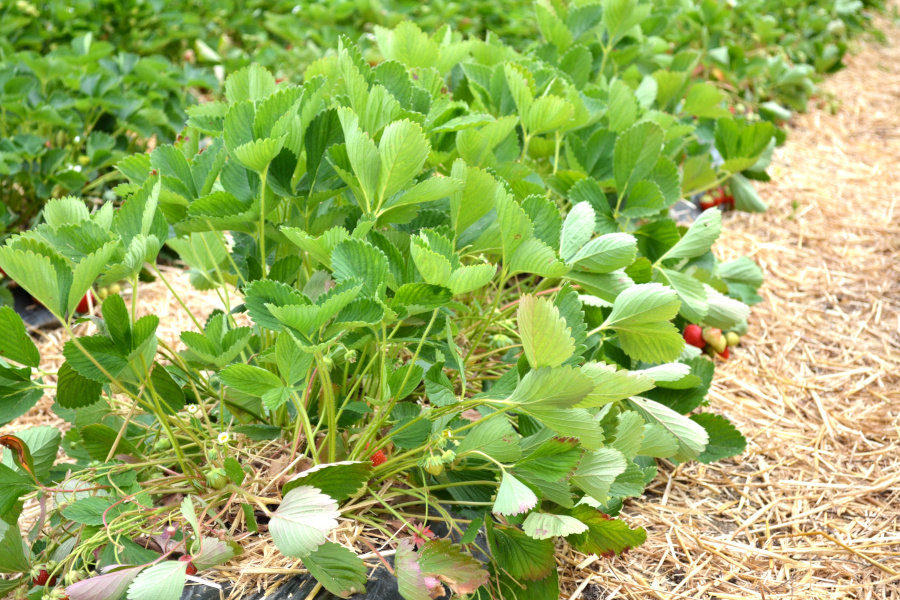
Spreading straw between the rows of plants offers several advantages.
Firstly, it protects the fruit from contamination, and secondly, it inhibits weed growth between the rows. In hot weather, the straw also protects the soil from drying out.

Harvesting
Strawberries should be harvested every 2 to 3 days. The harvest yield depends on the growing method. It is recommended to place the harvested strawberries in the sales tray immediately after picking to preserve their quality as much as possible. Subsequent rapid cooling is very important for the fruit’s shelf life.
Recent Comments