
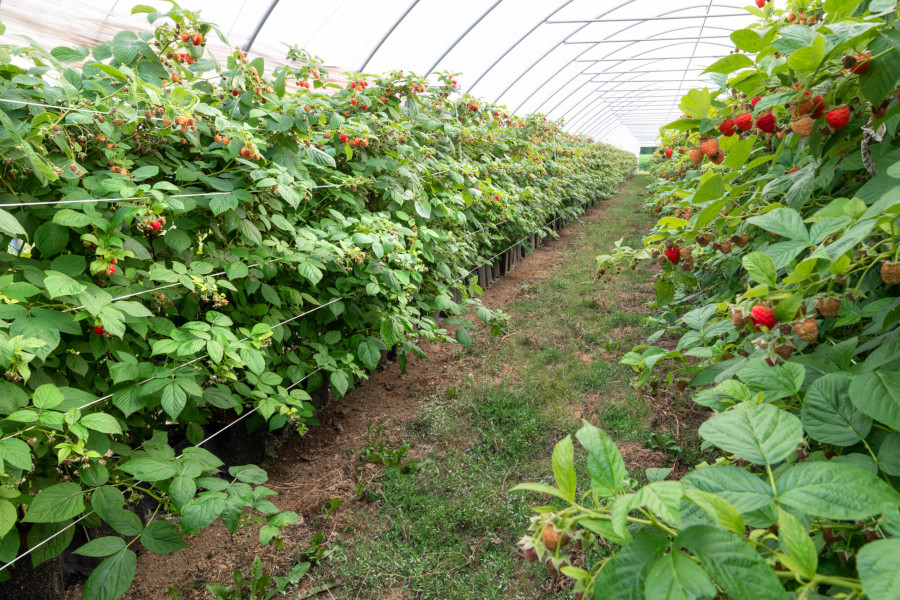
The cultivation of raspberry plants has become increasingly popular in recent years. New varieties and strategic cultivation methods are making this crop attractive once again.
To achieve consistently high quality, it is essential to select the right varieties, use high-quality planting material, and pay attention to the production process. The local conditions and possibilities must also be considered. Important factors include soil quality and location. Protected cultivation of raspberry plants is possible using tunnels, rain covers, or greenhouses. These methods largely protect the plants from sudden weather changes and allow them to be picked dry. This significantly improves marketability. Planning and implementing a staggered harvest, or early/late harvesting, is also feasible in protected cultivation. However, protected cultivation is not very worthwhile without guaranteed sales channels and corresponding prices.
Plugplants
Planting time: April to June
When cultivating potted plants, cuttings are planted and rooted in substrate, usually using planting trays. The potted plants are delivered with a root ball. Long cane plants, for example, can be cultivated from this type of plant. Potted plants are also well-suited for planting in open ground.
Planting of potted plants can begin in May, but optimal soil preparation should be ensured beforehand. For successful growth, it is important that the plants are no longer exposed to frost and receive optimal water and nutrient supply from the start. The cane length should reach 160-180 cm in the first year. Weed growth can be effectively controlled by ridge cultivation or the use of a plastic sheeting.
To allow for unrestricted growth, a planting distance of six plants per meter is recommended.
For the best possible results and to protect them from the wind, they should be supported with wire, a bamboo stake, or twine. The side shoots can also be secured with a net or with strings.
Long Canes
Planting time for potted long cane plants/containers: February-March
Long, pre-grown raspberry canes with buds, measuring approximately 1.60-2.00 meters in length, are called long canes. Thanks to the existing buds, a first harvest is possible in the planting year. Commercially available potted long cane plants are delivered in a 1.8-liter pot (container) and usually contain two raspberry canes.
For stabilization, they are trained on a trellis in the planting year. Once the canes have reached the desired length and the roots are well-developed, they are stored in a cold storage facility, similar to cold-storage plants, as soon as their winter dormancy begins. The following year, they are ready for cultivation, for example, in a polytunnel or under rain covers.
The harvest period begins approximately 9-12 weeks after the plants are set up or planted. The predictable planting date allows for precise timing of cultivation and ensures the desired harvest time. When planting, six canes per meter are recommended; this corresponds to three pots with two canes each. For growing long-cane raspberries, polytunnels or rain covers are primarily used.
Please note that the plants are only produced to order. The growers require your order by the beginning of May so that the desired plants can be delivered the following year.
Rasperry Canes
Planting time for bare-root canes: February-March/mid-October-mid-November
The one-year-old, woody raspberry canes are 50-60 cm long and have a well-developed root system. During their winter dormancy, the one-year-old plants are lifted, chilled, and replanted in autumn or spring. This type of plant is suitable for open-field cultivation with limited irrigation. The plants are planted in a single row, with a spacing of approximately 40-50 cm within the row, and a row spacing of approximately 3.00 m to 3.50 m. Depending on the training system, the planting requirement is 8,000-12,000 plants per hectare.
The planting direction should ideally be north-south. To prevent premature harvesting, it is recommended to prune the canes back to 20-30 cm after planting. Training and pruning during cultivation are crucial for successful raspberry cane cultivation. However, this is no longer a common cultivation method.
Recent Comments